Photo: JONATHAN CORUM, STF
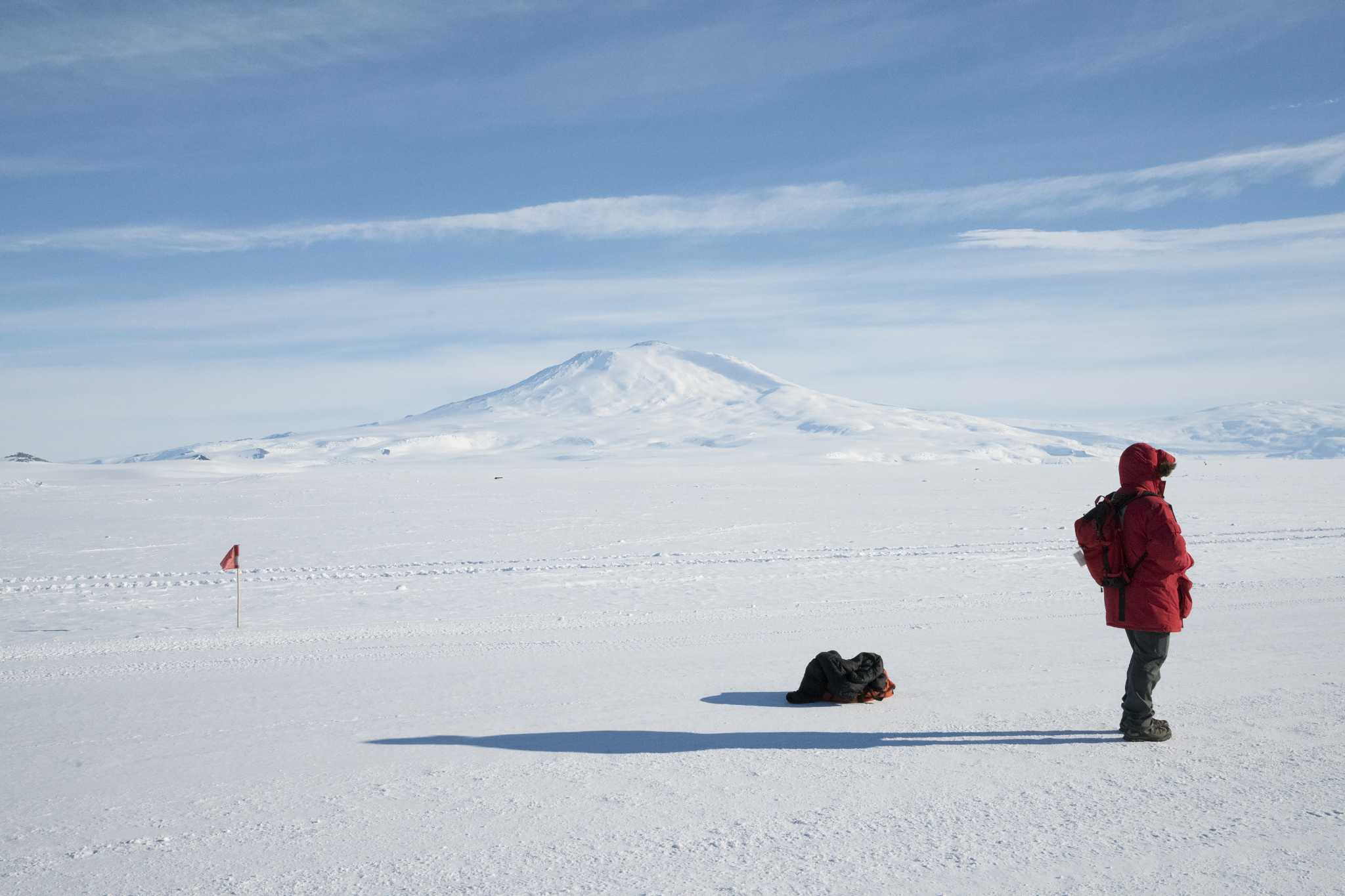
A McMurdo resident watches a NASA balloon launch while standing on the Ross Ice Shelf, with Mount Erebus in the distance, in Antarctica, November 2016.
Click through the gallery to see photos of polar ice melt on antarctica.
lessA McMurdo resident watches a NASA balloon launch while standing on the Ross Ice Shelf, with Mount Erebus in the distance, in Antarctica, November 2016.
Click through the gallery to see photos of polar ice melt
... more
Image 2 of 15
|
Antarctica melting due to global warming
In this Jan. 24, 2015 photo, German scientist Andreas Beck write down notes in Robert Island, in the South Shetland Islands archipelago, Antarctica. The melting of Antarctic glaciers as a consequence of global warming is concerning scientists as this contributes to rising sea levels which will eventually reshape the planet. The rising of sea levels will affects at least a billion people worldwide.
lessIn this Jan. 24, 2015 photo, German scientist Andreas Beck write down notes in Robert Island, in the South Shetland Islands archipelago, Antarctica. The melting of Antarctic glaciers as a consequence of global
... more
Image 3 of 15
|
Antarctica melting due to global warming
In this Jan. 26, 2015 photo, pieces of thawing ice are scattered along the beachshore at Punta Hanna, Livingston Island, South Shetland Island archipelago, Antarctica. Water is eating away at the Antarctic ice, melting it where it hits the oceans. As the ice sheets slowly thaw, water pours into the sea, 130 billion tons of ice (118 billion metric tons) per year for the past decade, according to NASA satellite calculations.
lessIn this Jan. 26, 2015 photo, pieces of thawing ice are scattered along the beachshore at Punta Hanna, Livingston Island, South Shetland Island archipelago, Antarctica. Water is eating away at the Antarctic ice,
... more
Image 4 of 15
|
Antarctica melting due to global warming
In this Jan. 20, 2015 photo, wooden arrows show the distances to various cities near Chile's Escudero station on King George Island, Antarctica. Thousands of scientists come to Antarctica for research. There are also non-scientists, chefs, divers, mechanics, janitors and the priest of the world’s southernmost Eastern Orthodox Church on top of a rocky hill at the Russian Bellinghausen station.
lessIn this Jan. 20, 2015 photo, wooden arrows show the distances to various cities near Chile's Escudero station on King George Island, Antarctica. Thousands of scientists come to Antarctica for research. There
... more
Image 6 of 15
|
Antarctica melting due to global warming
In this Jan. 22, 2015 photo, gentoo penguins stand on a rock near station Bernardo O'Higgins, Antarctica. The melting of Antarctic glaciers as a consequence of global warming is concerning scientists as this contributes to rising sea levels which will eventually reshape the planet. The rising of sea levels will affects at least a billion people worldwide.
lessIn this Jan. 22, 2015 photo, gentoo penguins stand on a rock near station Bernardo O'Higgins, Antarctica. The melting of Antarctic glaciers as a consequence of global warming is concerning scientists as this
... more
Image 7 of 15
|
Antarctica melting due to global warming
In this Jan. 25, 2015 photo, Chile's Navy ship Aquiles moves alongside the Hurd Peninsula, seen from Livingston Islands, part of the South Shetland Islands archipelago in Antarctica. This is also the place where a hole in the ozone layer, from man-made refrigerants and aerosols, parks for a couple months when sunlight creeps back to Antarctica in August. It triggers a chemical reaction that destroys ozone molecules, causing a hole that peaks in September and then closes with warmer weather in November.
lessIn this Jan. 25, 2015 photo, Chile's Navy ship Aquiles moves alongside the Hurd Peninsula, seen from Livingston Islands, part of the South Shetland Islands archipelago in Antarctica. This is also the place
... more
Image 8 of 15
|
Antarctica melting due to global warming
In this Jan. 22, 2015 photo, ice floats in the Bellingshausen Sea near Chile's O'Higgins station in Antarctica. The ice in Antarctica tells how levels of carbon dioxide, the heat-trapping gas, have fluctuated over hundreds of thousands of years.
lessIn this Jan. 22, 2015 photo, ice floats in the Bellingshausen Sea near Chile's O'Higgins station in Antarctica. The ice in Antarctica tells how levels of carbon dioxide, the heat-trapping gas, have fluctuated
... more
Image 9 of 15
|
Antarctica melting due to global warming
In this Jan. 22, 2015 photo, Gentoo penguins stand on rocks near the Chilean station Bernardo O'Higgins, Antarctica. Here on the Antarctic peninsula, where the continent is warming the fastest because the land sticks out in the warmer ocean, 49 billion tons of ice (nearly 45 billion metric tons), is lost a year according to NASA.
lessIn this Jan. 22, 2015 photo, Gentoo penguins stand on rocks near the Chilean station Bernardo O'Higgins, Antarctica. Here on the Antarctic peninsula, where the continent is warming the fastest because the land
... more
Image 11 of 15
|
Antarctica melting due to global warming
In this Jan. 24 2015 photo, German scientist Andreas Beck write down notes in Robert Island, in the South Shetland Islands archipelago, Antarctica. Water is eating away at the Antarctic ice, melting it where it hits the oceans. As the ice sheets slowly thaw, water pours into the sea, 130 billion tons of ice (118 billion metric tons) per year for the past decade, according to NASA satellite calculations.
lessIn this Jan. 24 2015 photo, German scientist Andreas Beck write down notes in Robert Island, in the South Shetland Islands archipelago, Antarctica. Water is eating away at the Antarctic ice, melting it where it
... more
Image 12 of 15
|
Antarctica melting due to global warming
In this Jan. 26, 2015 photo, pieces of thawing ice are scattered along the beachshore at Punta Hanna, Livingston Island, South Shetland Island archipelago, Antarctica. Water is eating away at the Antarctic ice, melting it where it hits the oceans. As the ice sheets slowly thaw, water pours into the sea, 130 billion tons of ice (118 billion metric tons) per year for the past decade, according to NASA satellite calculations.
lessIn this Jan. 26, 2015 photo, pieces of thawing ice are scattered along the beachshore at Punta Hanna, Livingston Island, South Shetland Island archipelago, Antarctica. Water is eating away at the Antarctic ice,
... more
Image 13 of 15
|
Antarctica melting due to global warming
In this Jan. 22, 2015 photo, Manuel Fuentes, a Chilean Navy member, pushes ice with a paddle from aboard a zodiac to get close to the Chile's "Aquiles" navy ship to carry international scientists to Chile'' station Bernardo O'Higgins, Antarctica. Water is eating away at the Antarctic ice, mostly from below, melting it where ice hits the oceans. As the ice sheets slowly thaw, water pours into the ocean.
lessIn this Jan. 22, 2015 photo, Manuel Fuentes, a Chilean Navy member, pushes ice with a paddle from aboard a zodiac to get close to the Chile's "Aquiles" navy ship to carry international scientists to Chile''
... more
Image 14 of 15
|
Antarctica melting due to global warming
In this Jan. 26, 2015 photo, Wenjun Li, a marine chemist from China, walks along the beach in search of samples in Punta Hanna, Livingston Island, South Shetland Islands archipelago, Antarctica. Parts of Antarctica are melting so rapidly it has become “ground zero of global climate change without a doubt,” said Harvard geophysicist Jerry Mitrovica.
lessIn this Jan. 26, 2015 photo, Wenjun Li, a marine chemist from China, walks along the beach in search of samples in Punta Hanna, Livingston Island, South Shetland Islands archipelago, Antarctica. Parts of
... more
NASA researchers: Arctic ice loss has tripled since 2012
Antarctic ice loss is causing sea levels across the globe to rise faster now than ever before in history, a NASA and European Space Agency assessment found.
The study, published in the journal Nature last week, examined Antarctic ice mass changes over 25 years, from 1992 to 2017. Scientists found that ice loss during that time caused global sea levels to rise .3 inches -- almost half of which occurred from 2012 on.
In short: researchers determined that ice loss has tripled since 2012, according to the study.
UNDERCOVER: Antarctica has mountain ranges and valleys bigger than Manhattan deep beneath its ice
This is significant because Antarctica "stores enough frozen water to raise global sea levels by 190 feet (58 meters), if it were to melt entirely," a post on NASA's website stated. "Knowing how much ice it's losing is key to understanding the impacts of climate change now and its pace in the future."
The full results of the study can be found here.
With two upcoming satellite missions, NASA will contribute even more to this kind of research in the coming years.
ANOTHER SHOT: NASA's problem-plagued, $8 billion James Webb telescope to get new launch date
The first mission, Gravity Recovery and Climate Experiment Follow-On (GRACE-FO), launched last month and is tasked with measuring changes in how mass is redistributed within Earth's atmosphere, land oceans and ice sheets, according to NASA.
The second, Ice, Cloud and land Elevation Satellite (ICESat-2), is slated to fly later this year and will use lasers and other instruments to measure Earth's surface elevation. This will help scientists calculate the height of glaciers, sea ice and forests.
Alex Stuckey covers NASA and the environment of the Houston Chronicle. You can reach her at alex.stuckey@chron.com or Twitter.com/alexdstuckey.
Let's block ads! (Why?)
https://www.chron.com/news/science-environment/article/NASA-researchers-ice-loss-has-tripled-since-2012-13014785.php
Bagikan Berita Ini


0 Response to "NASA researchers: Arctic ice loss has tripled since 2012"
Post a Comment